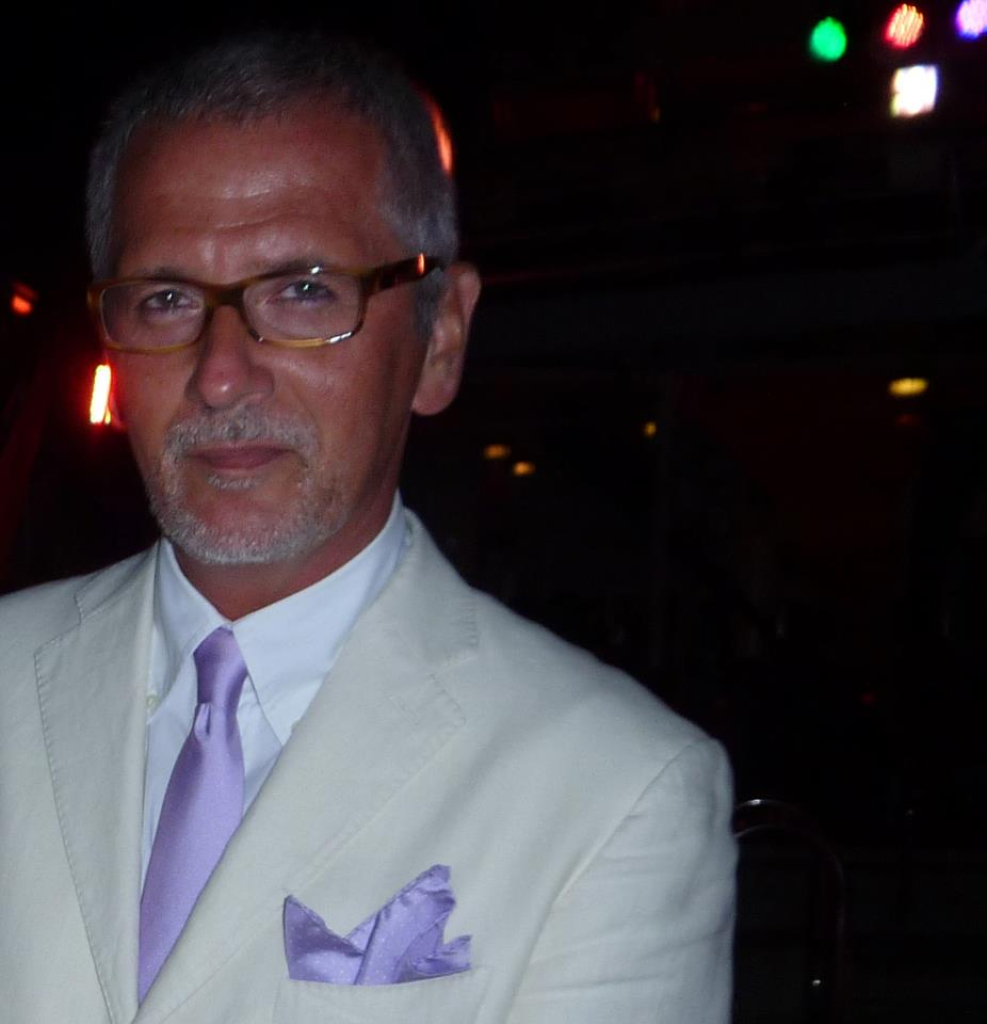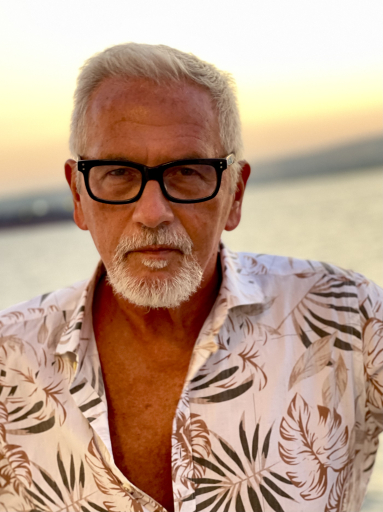
Born in Milan, Italy, in 1957, he was a pupil of Angelo Paccagnini (Electronic Music and Composition) and Niccolò Castiglioni (Composition) at the Verdi Conservatory in Milan, and made his debut as a composer in 1978 at the “UNESCO Music Workshop” in Copenhagen.
In 1980, with Le nuvole for chamber orchestra, he was awarded a prize - on the recommendation of Goffredo Petrassi - at the “Rassegna Internazionale di Musica e Teatro da camera” organized by the Associazione Filarmonica Umbra.
In 1981 he took part in the first edition of “Venezia Opera Prima” and in the “Biennale Musica” entitled “Dopo l’Avanguardia”, earning outstanding recognition from critics and public.
RAI chose Le nuvole to take part in the “International Tribune of Composers” in 1982 in Paris, commissioned the First Symphony for the Orchestra Sinfonica di Milano in 1983 conducted by John Mauceri, and in 1984 Notturno, Wonderland Variations and the orchestration of the piano cycle Come io passo l’estate by Niccolò Castiglioni for the Orchestra A. Scarlatti in Naples conducted by Roberto Abbado.
Since his debut at the Venice Biennale his music has been commissioned and performed in festivals, theatres and concert seasons in Italy and Europe. These have included the Pomeriggi Musicali in Milan, for whose orchestra he wrote the Second Symphony in 1990 and the Concerto for Strings in 1996; the Verona Arena, which in 1994 commissioned the Ouverture for orchestra, repeated in the 1995 season of the Accademia Nazionale di S. Cecilia in Rome conducted by Daniele Gatti; the Società del Quartetto in Milan, which presented the first performance in 1996 of the Lieder cycle Sette Canti Romantici, commissioned by the soprano Barbara Frittoli; in 1997 he wrote Nove Studi Spirituali for the Percussionists of La Scala, who gave the piece its first performance at the Ravenna Festival, and in the same year the Sagra Musicale Umbra presented the premieres of Divertimento for 14 instruments and Te lucis ante terminum for female chorus and piano (in memoriam N. Castiglioni); in 1998 at La Scala the Instrumentalists of La Scala performed the Quintet for clarinet and strings.
Between 1986 and 1992 he wrote the three-act opera Alice to a libretto by the poet Danilo Bramati, which had its premiere in 1993 at the Teatro Massimo in Palermo, Alessandra Ruffini/Carmela Remigio sopranos, directed by Sandro Sequi and conducted by Daniele Callegari; in 1997 Alice was released on CD on the AGORA’ label.
He has taught composition at the Conservatory of Trento-Riva del Garda, and since 1996 has contributed articles and reviews to Il Giornale della Musica.
In 1997 he orchestrated Liszt’s Weihnachtsbaum piano cycle and in 1998 Schumann’s Carnaval, commissioned and first performed by the orchestra of I Pomeriggi Musicali in Milan.
For the Easter celebrations in the year 2000 the Sagra Musicale Umbra has commissioned the psalm Haec dies for tenor and orchestra, to mark the occasion of the Jubilee Resurrection Mass.
From 2003 he write music for coreographer Emanuela Tagliavia and video-artist Davide Montagna: La lezione-M’encanta (Ravenna Festival 2007), 506 (Museum of Science and Technology of Milan, 2006) e Luminare Minus (Festival MI-TO, Milan, 2007) with dancers of Teatro alla Scala Dance School.
“Right from his debut at the Venice Biennale in 1981 I noticed Giampaolo Testoni for his authenticity and for the aristocratic elegance of his composing.
He was engaged in seething writing that obviously paid tribute to the avant-garde; but out of that fabric, changing and vibratile, he seemed intent on cutting a classic suit for himself.
An avant-garde which looked backwards.
Throughout his early works - surrounding the important Symphony No. 1 - Testoni aimed at maximum complexity of writing within the limits of legibility.
He initially belonged to the movement of “Neo-romantics”, he has pursued a unitary character in his works.
There is nothing in his music by way of indistinct shading, and everything in it converges towards an ideal of song in which the musical languages of the 20th century are reconsidered in artistic syncretism: this is not a question of nostalgia, but the certainly that the great current of tonal and post-tonal music is a living language which has not yet exhausted its expressive possibilities.
Testoni embraces this past at the same moment as he seems to idealize it, but the result is distanced from its model, since that is in the nature of things.
His music is endowed with an inner speed which may be connected with the expressive urgency of his artistic nature, indifferent to the categories of supposed modernity and bound instead to an idea of form into which the composer channels his superabundant invention.
Testoni knows that he has admirable skill as an orchestrator.
He elicits colours, vortices and velocities from the orchestra. He enchants with dream atmospheres. He fascinates with overwhelming power. And above all he has a highly attractive sense of musical beauty and “luxury”, without ever succumbing to decoration as an end in itself.
All this musical quality is however diverted towards expression that is taut and not in the least pacific. He reveals himself to be a dark and dramatic artist, not insensitive to instrumental subtleties, but with a powerful and visceral expressive nature.
There is no parody or allusion in him, but direct musical expressivity.
He writes mostly varied forms in which invention lies above all in transformation.
Testoni belongs to that line of composers given to uninterrupted musical thought which tends to be generated by a single theme: the elaborative system described by German musicology as “Forstspinnung”.
His symphonic-elaborative thinking presses forward with obsessive urgency. His composing even opulent and his anxiety to communicate lead him towards a unitary language born from the fusion of diverse models which work superimposed on each other.”
Franco Pulcini, musicologist